Business-led roadmap
Align the top team on vision, value cases, priority domains, investments, owners, and an execution sequence that works as a leadership contract.
Methodology
My approach is based on Rewired, McKinsey's guide to competing in the age of digital and AI: real transformation is not about installing tools; it is about building enterprise capabilities across leadership, talent, operations, technology, data, and adoption.
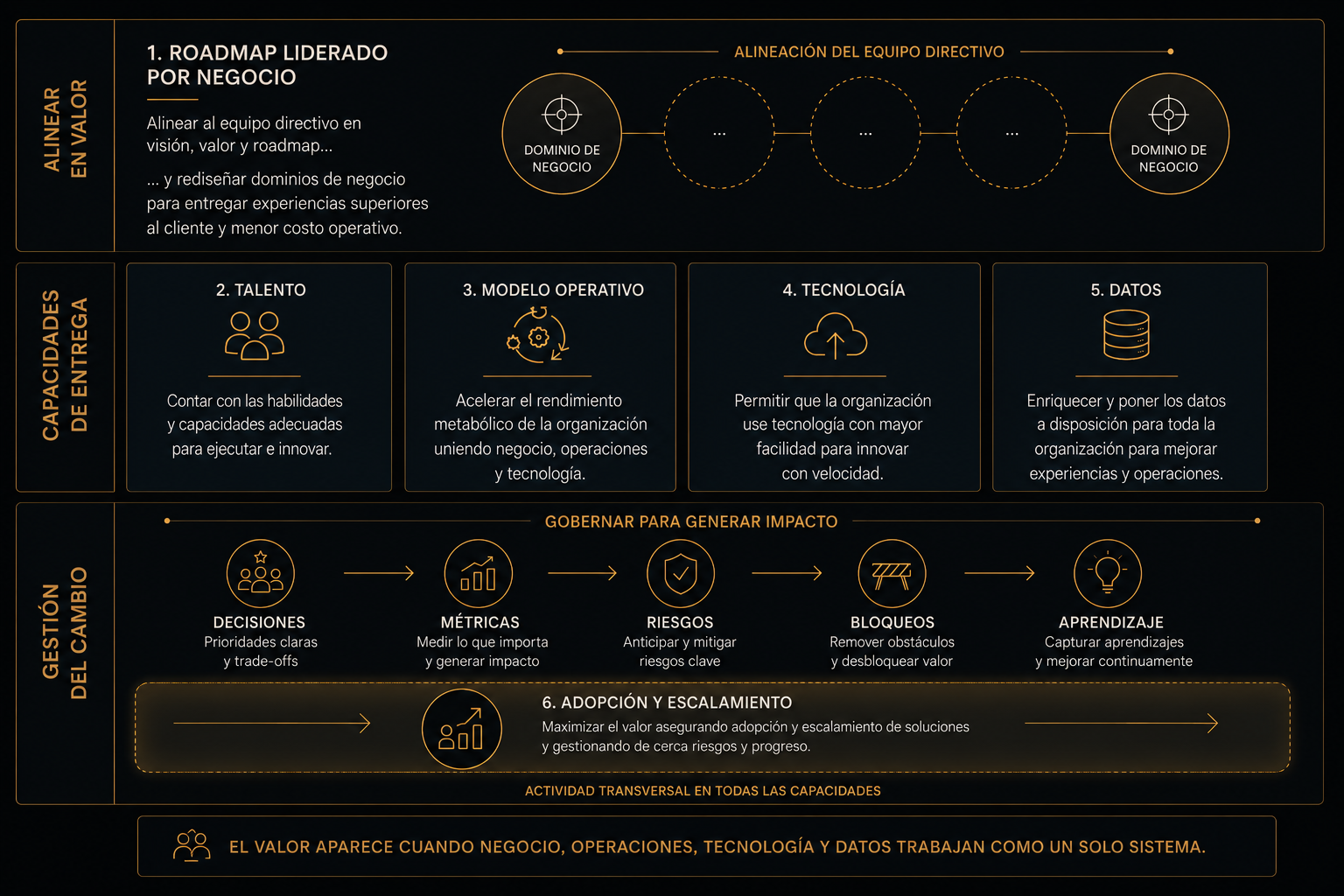
The six capabilities
Value appears when these capabilities are designed together. If one is missing, transformation becomes a collection of projects: some visible, few sustainable.
Align the top team on vision, value cases, priority domains, investments, owners, and an execution sequence that works as a leadership contract.
Define which capabilities must live inside the company, where partners can help, and how product, data, engineering, and operations can thrive.
Redesign how decisions and execution work: domain teams, clear ownership, cadence, governance, product, UX, and business-operations-technology collaboration.
Modernize architecture, integrations, cloud, APIs, automation, DevSecOps, and engineering practices so the organization can innovate without fragility.
Turn scattered data into reusable, governed, easy-to-consume products for reporting, decisions, automation, and AI initiatives.
Ensure solutions are used, real processes change, patterns scale where they should, impact is measured, and security, quality, and trust risks are managed.
How I will use it
The methodology translates McKinsey's frame into a practical intervention for mid-sized companies: diagnose, prioritize, design, execute, measure, and scale.
Define with leadership what transformation means: growth, margin, speed, customer experience, operational control, or risk reduction. Without ambition, technology becomes a shopping list.
Identify end-to-end processes that cross functions: lead to cash, order to delivery, support to retention, planning to reporting. Transformation is organized by domains, not org chart boxes.
Evaluate initiatives by impact, effort, dependency, risk, data readiness, expected adoption, and internal capacity. The output is a roadmap with decisions, not a wish list.
Define teams, owners, vendors, cadences, metrics, dashboards, decision criteria, and mechanisms to resolve blockers across business, operations, and technology.
Install or improve integrations, automation, data, dashboards, engineering practices, security, and AI patterns that support multiple use cases, not just one isolated project.
Move each solution into real usage, measure operational impact, adjust processes, capture learning, and replicate only what proves value. Transformation does not end at go-live.
Why it is cross-functional
Serious digital transformation touches decisions, incentives, processes, data, and ways of working. IT enables the change, but leadership and operations capture the value.
The C-suite decides where to compete, which capabilities differentiate, and which trade-offs are acceptable. Without sponsorship, projects lose priority.
Operational areas change workflows, roles, controls, and handoffs. Digitizing without redesigning operations only decorates friction.
Architecture, integrations, security, and automation make it possible for solutions to grow without relying on manual patches.
Every indicator needs a definition, source, owner, and cadence. Without trusted data, AI and dashboards amplify uncertainty.
The company needs internal capabilities to evolve solutions, learn quickly, and avoid permanent dependency on third parties.
The result is measured when users change behavior, the process improves, and the business metric moves.
Next step
If you want cross-functional transformation, start by locating the domain, value, missing capabilities, and execution system.